
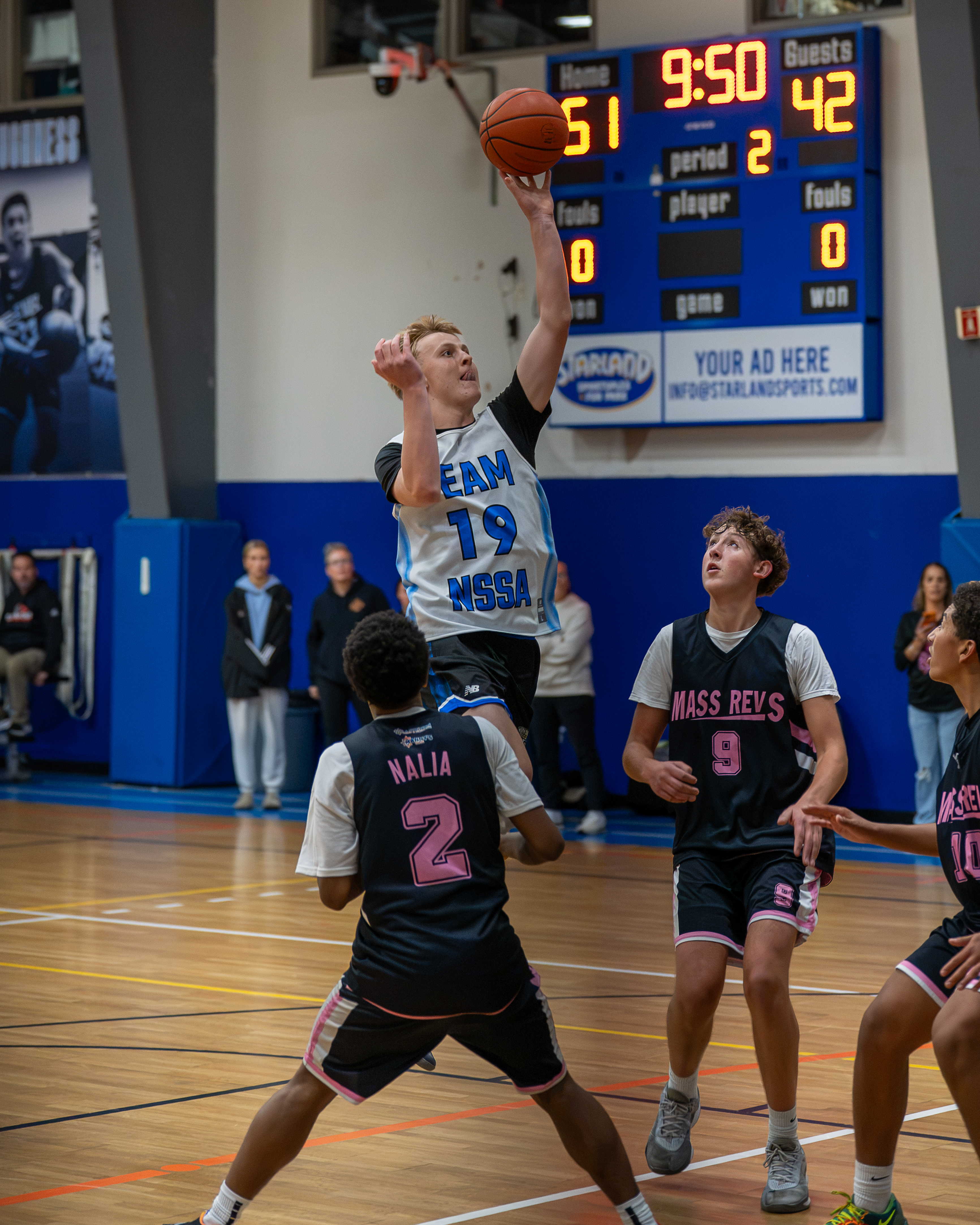
There are moments as a sports photographer when you have to make an important professional decision.
This past weekend, during the championship game between NSSA SC Varsity and Mass REVS at a sportsplex in Massachusetts, I had one of those moments.
The referee called a travel.
I disagreed.
Actually, "disagreed" might be putting it politely.
I was shooting from the baseline, camera in hand, watching the play unfold through my viewfinder, and every dad instinct in my body wanted to offer the officiating crew some immediate and completely unsolicited feedback.
I opened my mouth.
Then I stopped.
Because another thought entered my head:
This is a really good shooting spot.
And suddenly I had a decision to make.
Do I defend the honor of my son and his basketball team?
Or do I keep my mouth shut so the referee doesn't decide that the photographer standing in this very convenient location has suddenly become a safety concern?
I chose photography.
Barely.
The Problem With Being Dad AND the Photographer
Photographing your own kid's games is a little different than photographing a team you don't have an emotional connection to.
When I'm covering another game, I can stay pretty neutral.
Bad call?
Interesting.
Missed foul?
That's unfortunate.
Questionable out-of-bounds call?
These things happen.
When it's my son playing?
Apparently, I have access to instant replay from 75 feet away while looking through a Nikon viewfinder.
It's amazing.
Of course, logically, I know the referees are making decisions in real time. Basketball moves incredibly fast, particularly once you get to varsity-level AAU basketball.
But logic occasionally disappears when your kid gets called for something you are absolutely convinced you saw differently.
That's when I have to remind myself:
Rob, you are holding several thousand dollars worth of camera equipment.
You are not an assistant coach.
Varsity Basketball Moves FAST
Basketball may be one of my favorite sports to photograph because there is almost no downtime.
A possession can go from one end of the court to the other in seconds.
One moment I'm photographing a guard bringing the ball across half court.
Then there's a pass to the wing.
A drive.
Help defense collapses.
The ball gets kicked back out.
Shot.
Rebound.
Outlet pass.
And suddenly everybody is sprinting directly away from me.
If you hesitate, you missed it.
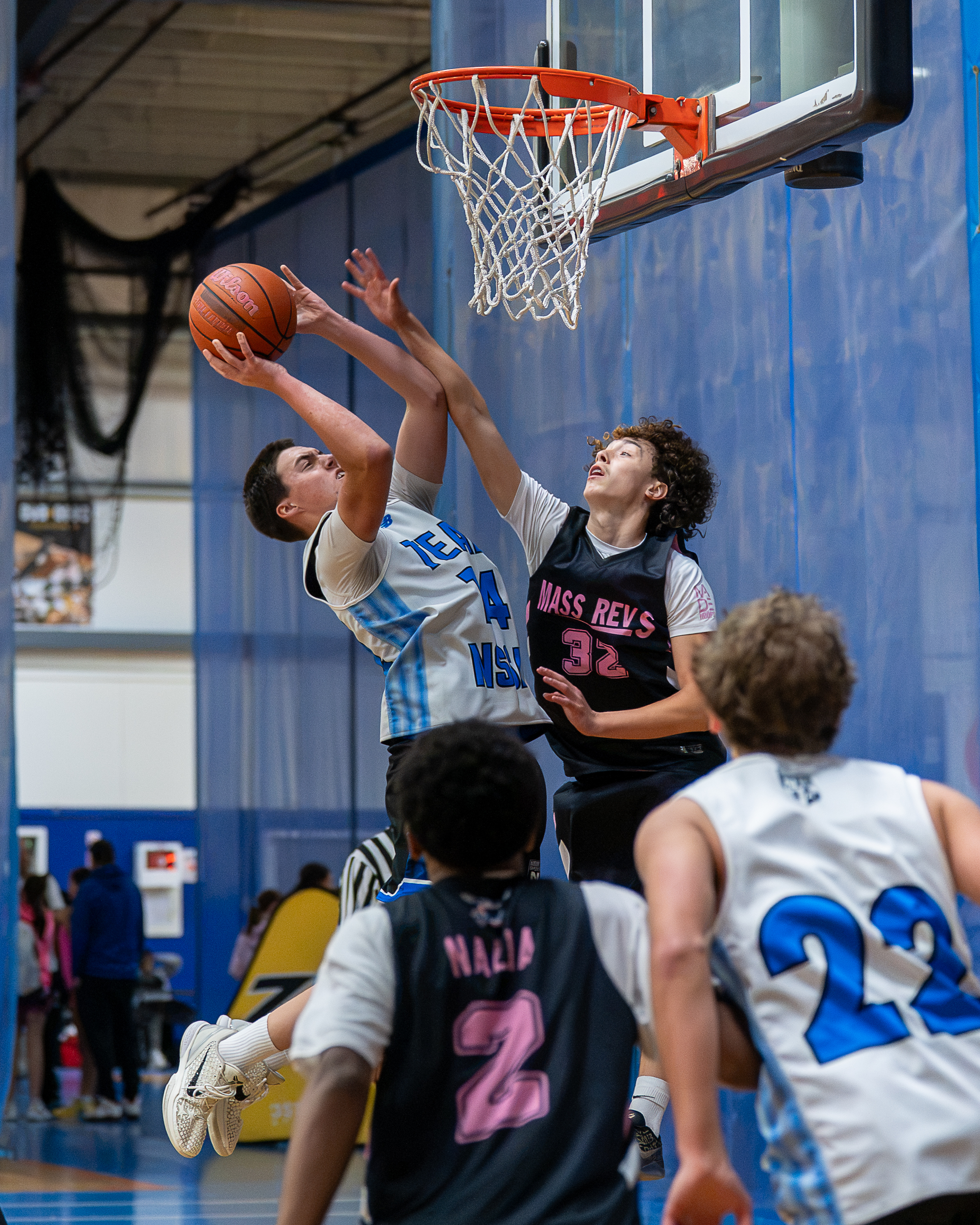
That means I'm constantly trying to think one or two plays ahead.
Where is the action likely to happen?
Who is cutting?
Is someone setting up in the corner?
Is the ball handler likely to drive?
And most importantly:
Am I about to get run over?
There's an interesting combination of concentration required when photographing basketball. You're trying to track the action, anticipate the next play, watch your framing, keep an eye on your exposure, and somehow maintain enough peripheral vision to notice a 6-foot-something athlete charging toward your position.
All while trying not to yell at the referee.
And Then There's Gym Lighting
If you photograph high school or AAU basketball long enough, you learn something very quickly:
Not all gyms were designed with photographers in mind.
Some gyms actually have pretty decent lighting.
Others appear to have been illuminated using whatever fluorescent fixtures somebody found in a warehouse in 1987.
You can move ten feet down the baseline and suddenly lose a noticeable amount of light.
One end of the court may look great.
The other end looks like basketball is being played inside a cave.
You also get strange color shifts from overhead lights, dark backgrounds, bright floors and occasionally light fixtures positioned perfectly to create highlights where you absolutely do not want them.
Meanwhile, the game does not care.
The players aren't slowing down because my ISO is getting uncomfortable.
That's the challenge.
With basketball, I need enough shutter speed to freeze movement, enough aperture to gather light and an ISO high enough to make the whole thing work.
Sometimes the camera settings are not about what would theoretically create the cleanest image.
They're about what gives me the best chance of actually capturing the moment.
A sharp, slightly noisy photograph beats a beautifully exposed photograph of somebody who has already left the frame.
Positioning Tip #1: Find Your Background Before the Game Starts
One thing I've learned is that the best shooting location isn't necessarily the closest location to the basket.
Before the game starts, I look around the court and pay attention to what will be behind the players when I'm shooting.
Bleachers full of people?
A dark wall?
A doorway?
A bright scoreboard?
A bench full of players?
Those backgrounds make a huge difference.
I'll usually look for a position along the baseline or slightly toward the corner where I can photograph drives toward the basket while keeping the background as clean as possible.
Then I look at the light.
If one section of the court gives me cleaner light and a better background, I'm going to protect that spot.
Which brings us right back to why arguing with referees becomes a questionable photography strategy.
There are only so many good places to stand.
I'd rather not get relocated.
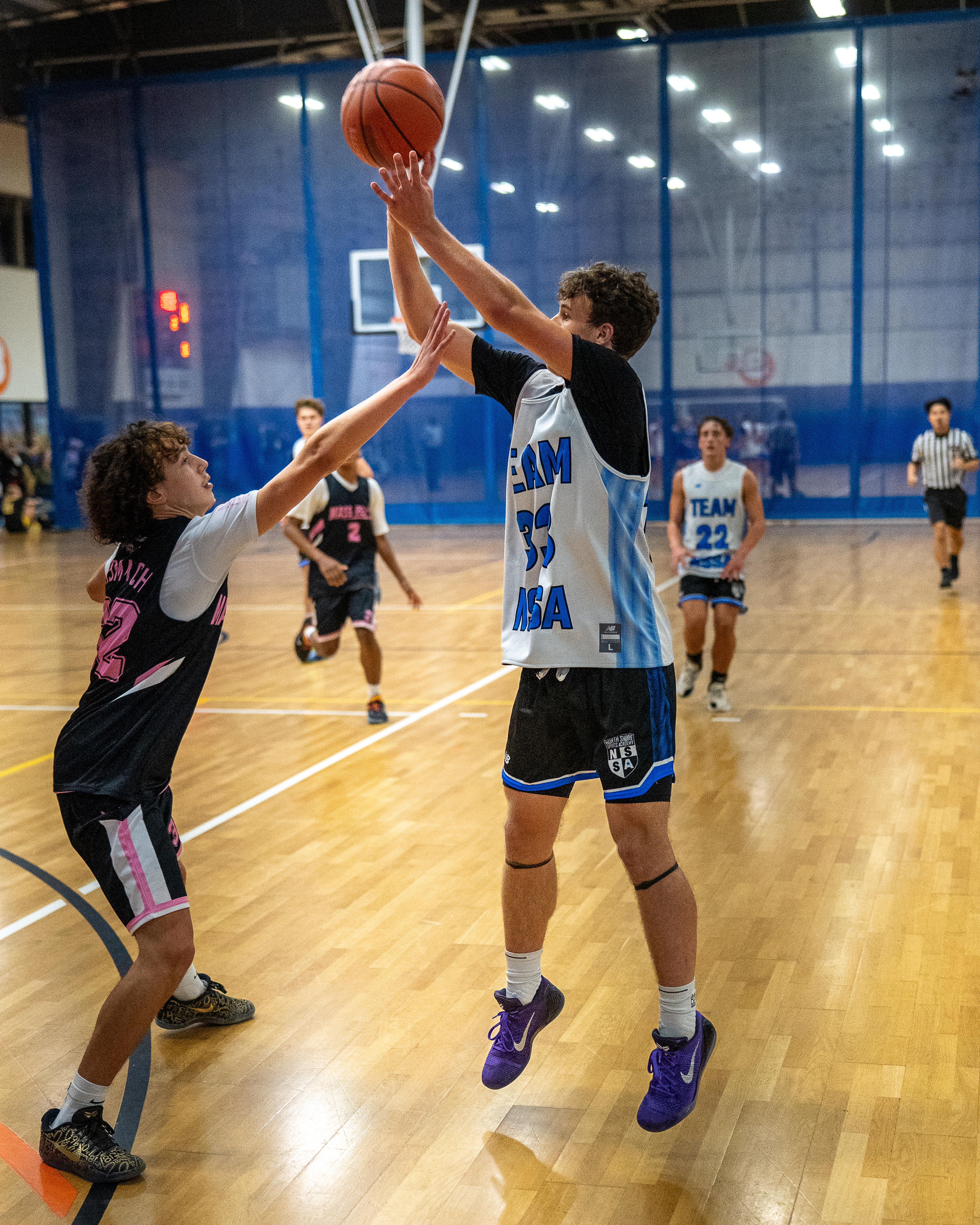
Positioning Tip #2: Don't Photograph Everything From One Spot
Once I know I have my safe baseline position, I still try to move when the game situation allows it.
A low baseline position is fantastic for drives, rebounds and action around the basket.
But staying there for an entire game can make the gallery feel repetitive.
Moving toward the corner or farther up the sideline can give you better opportunities for ball handlers, defensive pressure, passes and player reactions.
The trick is knowing when to move.
Basketball changes direction so quickly that randomly wandering around the gym is a great way to find yourself in exactly the wrong place when something happens.
I generally want a reason for changing positions.
Different background.
Different light.
Different type of shot.
If none of those things are changing, moving probably isn't helping me.
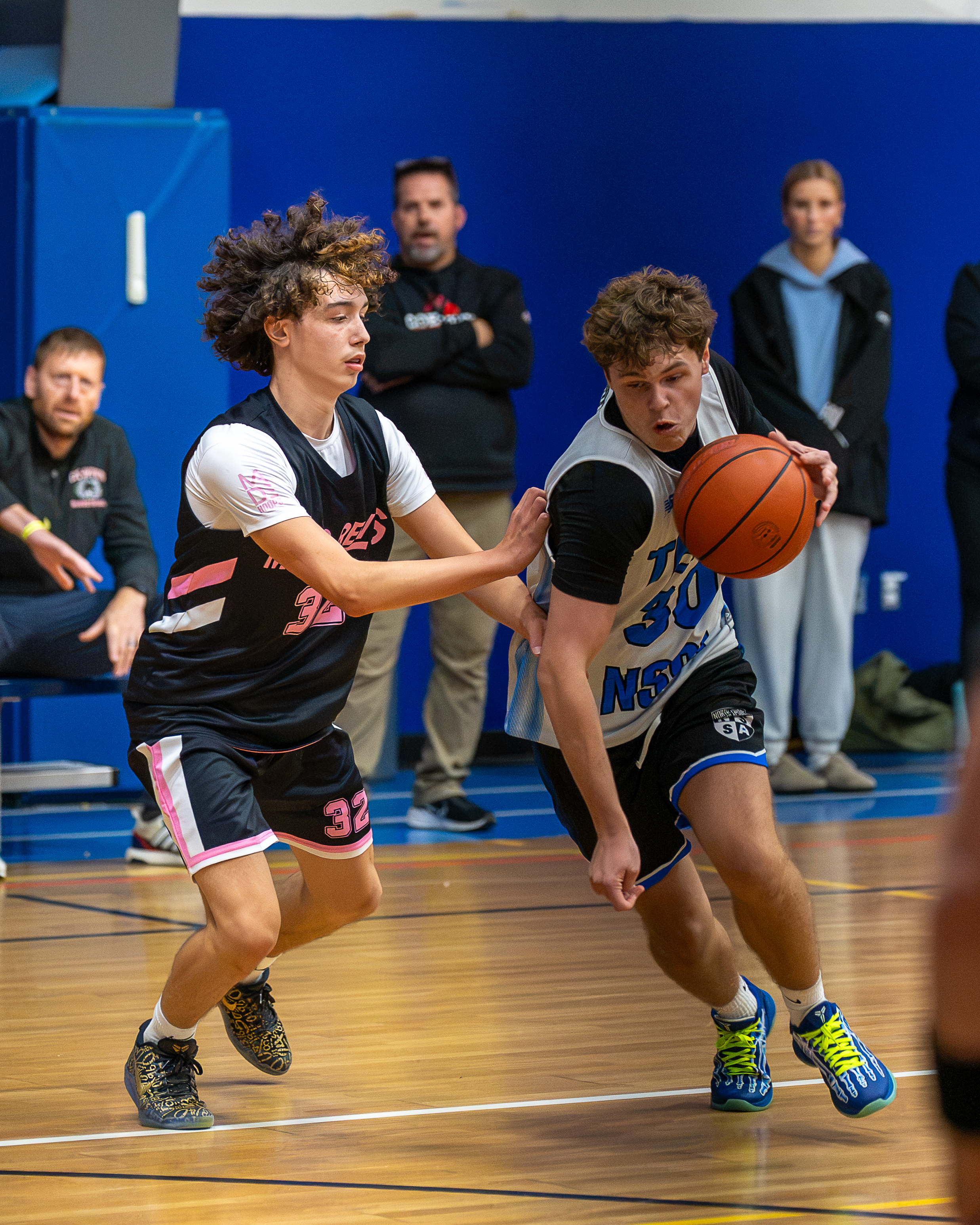
The Shots Mean More When It's Your Kid
There's another part of photographing my son's basketball games that I don't always talk about.
I'm documenting something I'm personally invested in.
That's different.
I'm obviously trying to create strong sports photographs. I want peak action, expressions, intensity and all the things I would want when photographing any athlete.
But every once in a while I'll lower the camera and realize:
That's my kid out there.
Travel sports move quickly.
Seasons move quickly.
Kids grow up ridiculously quickly.
Someday these games are going to exist mostly as stories, memories and photographs.
And I'm lucky enough to have a front-row seat with a camera.
Even if occasionally that front-row seat requires me to exercise an extraordinary amount of self-control.
Photographer Rob vs. Dad Rob
I'm getting better at separating the two.
Photographer Rob knows the referee probably had a different angle.
Dad Rob knows the referee is obviously wrong.
Photographer Rob understands that officiating varsity basketball at full speed is incredibly difficult.
Dad Rob would be happy to explain the rules.
At length.
Possibly with visual aids.
Photographer Rob also understands something extremely important:
The light from this spot is excellent.
So during that championship game between NSSA SC Varsity and Mass REVS at a sportsplex in Massachusetts, when that travel was called and I felt that familiar urge to say something, I did what any mature, disciplined professional photographer would do.
I kept my mouth shut.
Mostly.
Then I raised the camera back to my eye and waited for the next possession.
Because there are plenty of people in the gym capable of yelling at the referees.
But somebody has to get the pictures.
And as Dad Rob, I'd like to end with a thank you to all of the coaches, athletes, and sports parents I've gotten the chance to chat with, get to know, and, of course, photograph along the way.
Photography may be what puts me on the baseline with a camera in my hands, but the people I've met through sports are a big part of what keeps me coming back.